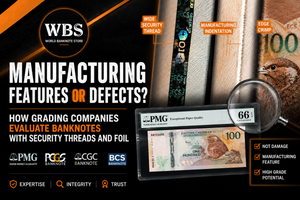

Banknotes, as collectible items, captivate numismatists not only with their aesthetics but also with their technological complexity. Modern paper and polymer banknotes are the result of the work of leading global companies that combine advanced security technologies with innovative materials. This article explores key banknote manufacturers, their unique technologies, and features that make contemporary banknotes so fascinating for collectors.
Paper and Polymer Banknotes: Production Basics
Paper banknotes are traditionally made from cotton paper or a blend of cotton and linen, which provides a distinctive texture and durability. Polymer banknotes, first introduced in Australia in 1988, are made from biaxially oriented polypropylene (BOPP). Polymer banknotes are notable for their longevity, resistance to moisture, and complex security features, such as transparent windows. For collectors, these characteristics add uniqueness, as each banknote is a technological work of art.
Leading Banknote Manufacturers
1. De La Rue (United Kingdom)
De La Rue, founded in 1821, is one of the oldest and most renowned banknote manufacturers in the world. The company works with central banks of dozens of countries, including the United Kingdom, India, and Sri Lanka. De La Rue produces both paper and polymer banknotes based on its Safeguard® substrate. Their banknotes are celebrated for innovative security features, such as holograms, microtext, and optically variable inks. For collectors, the polymer banknotes of the United Kingdom (e.g., 5, 10, and 20 pounds) are particularly appealing due to their unique transparent windows featuring portraits of historical figures.
2. Giesecke+Devrient (G+D) (Germany)
The German company G+D is a leader in producing both paper and hybrid banknotes (a combination of paper and polymer). Their Hybrid™ substrate enables the creation of banknotes that blend the durability of polymer with the texture of paper. G+D collaborates with countries in Europe, Asia, and Africa, incorporating security features like magnetic threads and inks that change color depending on the viewing angle. Collectors value G+D banknotes for their technological sophistication and design diversity.
3. Crane Currency (United States)
Crane Currency is a key supplier of paper for U.S. banknotes (U.S. dollars) and many other countries. The company is known for its Motion Surface® technology, which uses micro-optical elements to create a motion effect on banknotes. For numismatists, U.S. dollars produced by Crane are a classic collectible, while their hybrid substrates add a modern charm.
4. Oberthur Fiduciaire (France)
Oberthur Fiduciaire specializes in paper banknotes supplied to countries in Europe, Africa, and Latin America. Their banknotes feature special coatings to enhance wear resistance, making them attractive to collectors who value preservation. While the company is less active in producing polymer banknotes, its products stand out for their refined design.
5. Note Printing Australia (NPA) (Australia)
NPA, a subsidiary of the Reserve Bank of Australia, is a pioneer in polymer banknote production. Their Guardian® technology became the foundation for banknotes in Australia, New Zealand, Canada, and other countries. NPA’s polymer banknotes feature transparent windows with integrated holographic elements, making them unique for collectors. For example, Australian dollars featuring Indigenous motifs are a true gem for numismatists.
6. CCL Secure (Australia)
CCL Secure, formerly known as Innovia Security, focuses exclusively on polymer banknotes. Their Guardian® substrate is used in over 30 countries, including Canada, Mexico, and the United Kingdom. For collectors, these banknotes are appealing due to their eco-friendliness, durability, and complex security features that are difficult to replicate.
7. Louisenthal (Germany)
Louisenthal, a division of G+D, specializes in paper and hybrid substrates for banknotes. Their watermarks, security threads, and holographic stripes are a standard of quality. Collectors appreciate Louisenthal banknotes for their attention to detail and elegance.
8. Canadian Bank Note Company (CBN) (Canada)
CBN is known for producing Canada’s polymer banknotes, which fully transitioned to polymer in 2013. Their banknotes feature transparent windows with detailed holograms, making them popular among numismatists seeking modern specimens.
Security Features: What Attracts Collectors
Modern banknotes are not just a means of payment but also technological masterpieces. Here are some security features that make them special for collectors:
-
Transparent windows (typical of polymer banknotes): For instance, Canadian dollars feature holographic maple leaf images.
-
Micro-optics: Crane Currency’s Motion Surface® technology creates a motion effect that is hard to forge.
-
Optically variable inks: Color changes depending on the viewing angle, as seen in G+D banknotes.
-
Microtext and watermarks: Traditional elements of paper banknotes that add authenticity.
Conclusions
Banknote production is a fusion of art, technology, and security. Companies like De La Rue, G+D, Crane Currency, NPA, and CCL Secure create banknotes that not only serve economies but also become objects of fascination for numismatists. For collectors, these banknotes are true treasures due to their unique materials, designs, and security features. By collecting banknotes, numismatists gain the opportunity to connect with the history of technology and the culture of countries worldwide.
Vitalii Cherniuk (IBNS 13299-R)
CEO World Banknote Store