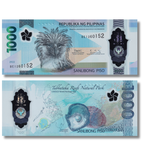

The release of a new variation of the 1000 Peso Philippine banknote (B1103.5a) was recently confirmed. This banknote, printed on paper, measures 160 x 66 mm and is part of a series signed by President Ferdinand Marcos Jr. and Bangko Sentral ng Pilipinas Governor Eli Remolona. It combines elements of national pride, history, and modern security technologies. The design of the banknote is striking in its symbolism. The front side features a crowd during the celebration of the Philippine Centennial of Independence in 1998, recalling a key moment in the country's history. There is also a gold and green SPARK Live rolling bar to indicate the denomination, an Optical Variable Element (OVI) with the South Sea pearl in an oyster, and the portraits of three national heroes: Jose Abad Santos, Josefa Llanes Escoda, and Vicente Lim. The seals of the President of the Philippines and the Bangko Sentral ng Pilipinas complete the composition. The reverse side features a map of the Philippines with an emphasis on the Tubbataha Reefs (a UNESCO World Heritage site), the pearl in an oyster (Pinctada Maxima), a sea turtle, and the T'nalak design (a traditional abaca pattern from Mindanao). A 5 mm wide security thread with demetallized BSP / 1000 lettering on the T'nalak textile pattern, a watermark with the heroes' portraits, and an electrotype 1000 ensure a high level of security. The history of the 1000 Peso banknote dates back to previous years. The first such banknote was issued by Bangko Sentral ng Pilipinas in 1991 as part of the New Design Series (NDS), also known as the BSP Series. At that time, the front side also featured the portraits of Jose Abad Santos, Vicente Lim, and Josefa Llanes Escoda—World War II heroes who symbolized resistance to the Japanese occupation. This series co-existed with later updates, such as the New Generation Currency in 2010, where the design was refined for better protection against counterfeiting. In 2017, an updated version was released with changes in the font and issue date. These banknotes have always underscored national identity, combining historical figures with the country's natural treasures. One of the stories from previous years concerns the heroes themselves depicted on the banknote. During World War II, in 1942, Jose Abad Santos, then Chief Justice of the Supreme Court of the Philippines, was captured by Japanese forces. He refused to cooperate with the occupiers, demonstrating unwavering loyalty to the country. Before his execution, he told his son: "Do not cry, Pepito. Show these people that you are brave. It is a rare opportunity for me to die for our country. Not every man is given that chance." Similarly, Josefa Llanes Escoda, founder of the Girl Scouts of the Philippines, actively aided guerrillas by supplying food and medicine to prisoners, for which she was arrested and executed in 1945. Vicente Lim, the first Filipino general and a West Point graduate, led the resistance and was executed in 1944. Their stories are examples of self-sacrifice during the occupation that continue to inspire Filipinos today. An example of using the banknote in daily life is checking its authenticity. Imagine receiving 1000 pesos at a store: tilt the banknote under the light, and the gold and green SPARK Live bar will begin to "move," changing color. This is a simple way to verify that the banknote is genuine, as such technology is difficult to counterfeit. This element not only protects against fakes but also makes the currency convenient for daily circulation, such as when paying for goods in Manila or on the islands. This new banknote highlights the evolution of the Philippine currency, combining tradition with innovation. As Vicente Lim said: "If we desire the respect of other nations, we must show them that we are exerting every effort to build a nation not only strong in arms but also unconquerable in spirit." It recalls the heroes of the past and the natural beauty of the Philippines, fostering national unity. With the release of this variation in 2024, the Bangko Sentral ng Pilipinas continues the tradition of updating the currency for better security and longevity.
Vitalii Cherniuk (IBNS 13299-R)
CEO World Banknote Store