
Introduction and Key Features
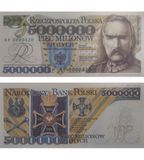
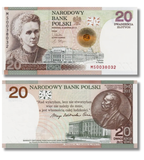
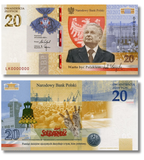
The National Bank of Poland (NBP) has issued a collector banknote with a nominal value of 20 złoty, dedicated to the millennium of the coronation of Bolesław the Brave. This issue has become an important contribution to the NBP series of commemorative banknotes. The banknote measures 170 × 85 mm and has a mintage of up to 70,000 copies. It is produced by the Polish Security Printing Works (Polska Wytwórnia Papierów Wartościowych SA). The design was created by Agnieszka Prchniak.
Obverse of the Banknote
The obverse features a portrait of Bolesław the Brave based on an engraving by Rudolf Fryderyk Friedlein, which was inspired by the portrait of the king created by Marcello Bacciarelli. Next to it is a decorative security stripe in gold and silver colours with a fragment of the Gniezno Doors framing and the banknote's nominal value.
In the center is the year 1025, visible in UV light as a security element. In the lower right corner is a recto-verso element with a stylized fragment of the spearhead from Netno. The microtext on this side contains the epitaph from the king's sarcophagus: "Inclyte dux tibi laus strenue Boleslae / Przesławny wodzu, chwała tobie, dzielny Bolesławie" (Translation: "Illustrious leader, glory to you, brave Bolesław").
Reverse of the Banknote
The reverse side has a vertical compositional arrangement. It depicts three panels of the Gniezno Doors: the ransom of St. Adalbert's body from the Prussians by Bolesław the Brave, the transfer of the saints' bodies, and the burial of the remains in Gniezno. Also shown are the obverse and reverse of the "Princes Polonie" coin from the time of Bolesław the Brave, as well as the spearhead of St. Maurice.
The scenes from the Gniezno Doors and the obverse of the coin are visible in UV light. On this side is a crown-shaped window cut into the paper, through which a gold fragment of the security stripe from the obverse is visible. In transmitted light, the window has a blue colour. The microtext repeats the epitaph from the obverse.
Security Features
The banknote is equipped with modern security elements. These include: a watermark with a fragment of the Gniezno Doors framing and the year of the coronation; intaglio printing; a crown-shaped window; iris printing; shortened typographic numbering; elements visible in daylight and UV light; microtext; embossed elements; recto-verso printing; iridescent elements; a holographic stripe with a blue window in transmitted light. These features ensure authenticity and complicate counterfeiting.
Historical Significance
The coronation of Bolesław the Brave in 1025 is a key event in Polish history. It concluded a series of achievements of the king's reign, including the creation of the Gniezno Archdiocese. This strengthened the state, promoted Christianization, and protected the population from slavery. The alliance with Emperor Otto III and victories over Henry II elevated Poland's prestige. The "Princes Polonie" coin recorded the Latin name of the country for the first time, emphasizing its equality with other Christian states.
Centuries later, this event inspired Poles to fight for independence, especially during the partitions. Professor Andrzej Pleszczyński emphasizes: the coronation immortalized the conviction of the equality of the Polish community with the leading nations of Europe.
Vitalii Cherniuk (IBNS 13299-R | Vice-President of Mosaic Chapter)
CEO World Banknote Store