
Khartoum, November 10, 2025 – The Central Bank of Sudan (CBOS) announced on November 6–7 the issuance of new 500 and 2000 Sudanese Pound (SDG) banknotes, 2025 series. This move, in accordance with the Central Bank Law of 2002 (as amended), aims to enhance protection against counterfeiting, optimize cash transactions, and stabilize the economy amid the ongoing crisis. The banknotes are produced by the Sudan Currency Printing Press (SCPP) on cotton paper featuring a watermark of the Secretary Bird—a symbol of the Sudanese national emblem.
The new 2000 SDG denomination is a significant innovation, intended to facilitate daily payments amidst high inflation. The banknote measures 160 × 72 mm with dominating shades of green and yellow. The obverse features typical representatives of Sudan's fauna, including cattle, highlighting the country's agrarian heritage. The reverse showcases the ruins of the ancient Apedemak Temple—a monument of the Nubian civilization. Security features include a Secretary Bird watermark with the denomination, a segmented strip with a geometric pattern and the acronym CBOS, a color-shifting element in the shape of a flying bird, high relief printing, and hidden images. Tactile marks for the visually impaired are applied along the edges of the obverse.
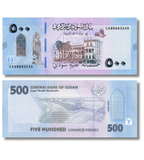
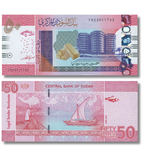
The updated 500 SDG banknote retains the size of 156 × 66 mm with shades of blue and brown. The obverse depicts the Old Republican Palace in Khartoum and relics of ancient civilizations, while the reverse shows the confluence of the White and Blue Nile, symbolizing unity. The security is analogous: watermark, segmented strip with CBOS, high relief printing, hidden elements, and tactile marks. The official date of introduction is June 2025, although the CBOS has not specified the distribution schedule.
This issuance occurs against the backdrop of the third year of civil war between the Rapid Support Forces (RSF) and the regular army, which has led to a 40% loss of GDP, infrastructure destruction exceeding $200 billion, and poverty for 71% of the population. Inflation reached 83.47% in September 2025, unemployment hit 47%, and the black market dollar exchange rate exceeded 3700 SDG, making the 2000 SDG equivalent to just $0.54. Previous reforms, such as the issuance of new 500 and 1000 SDG notes in 2024, also aimed to combat counterfeiting prevalent in conflict zones.
Economists, including Ahmed Ben Omar and Nazik Shamam, offer a mixed assessment of the initiative. On one hand, the larger denomination will increase transactional efficiency and reduce the volume of cash held outside banks, fostering liquidity. On the other hand, printing new notes without adequate backing (gold and export reserves are limited) may expand the money supply, accelerate inflation, and weaken the Pound. Analyst Hala Hamza notes that without strict control over gold and export revenues, the reform risks worsening the situation. The new CBOS leadership under Amna Mirghani positions the move as part of monetary stabilization, but critics label it a "contradictory policy" amid a currency shortage.
The issuance of new banknotes is not just a technical update but a signal of CBOS's reform intentions. However, success will depend on broader measures: strengthening banking supervision, combating counterfeiting, and restoring peace. Sudan, as one of Africa's largest gold producers, has the potential for stabilization if resources are directed into the financial system. Citizens and businesses await implementation details to avoid chaos in circulation.
Vitalii Cherniuk (IBNS 13299-R)
CEO World Banknote Store