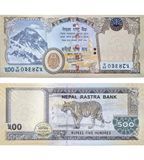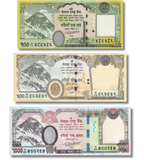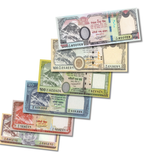

On November 27, 2025, the Central Bank of Nepal (Nepal Rastra Bank, NRB) introduced a new series of 100-rupee banknotes into circulation. This currency, equivalent to approximately 0.75 US dollars, is one of the most common in daily transactions. The banknotes retain the familiar size (152 × 66 mm) and predominantly green colour but feature an updated design approved in 2081 according to the Nepali calendar (2024 in the Gregorian calendar). Serial numbers range from 20 000001 to 40 999999, with the guarantee phrase: "The guarantee of the Government of Nepal ensures the immediate payment of 100 rupees." The release covers millions of units, replacing part of the previous 2019 series, where only numbers from 18 000001 to 19 034500 were issued.
Design of the obverse side: Symbols of nature and heritage
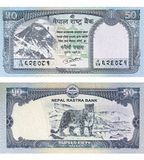
The obverse side of the banknote reflects key elements of Nepalese identity. The image of Mount Everest – the world's highest peak (8848 m), a symbol of the nation's unconquerable strength – dominates on the left. On the right is a watermark in the form of a laliguras (rhododendron), Nepal's national flower that blooms in the Himalayas. The central part is adorned with a detailed map of the country, updated in accordance with the 2020 constitutional changes. Below is the Ashoka Pillar with the inscription "LUMBINI THE BIRTH PLACE OF LORD BUDDHA," recalling the world heritage: Lumbini – a UNESCO site, the birthplace of Siddhartha Gautama. A tactile black dot is added near the pillar for the visually impaired, and a silvery image of Maya Devi, Buddha's mother, is in the oval frame on the left. The signature of Governor Maha Prasad Adhikar, who held the position until 2025, is located at the bottom.
Reverse side: Fauna and institutions
The reverse side focuses on biodiversity. In the center is an image of a solitary Indian rhinoceros (Rhinoceros unicornis) with a calf, symbolizing conservation efforts in Chitwan National Park, where the population has grown from 100 in the 1960s to over 750 in 2024 thanks to UNESCO programs. The upper part contains the inscription "NEPAL RASTRA BANK" in English, and the lower frame contains "RUPEES ONE HUNDRED" and the serial number "2024 A.D.". This design highlights Nepal's ecological mission, where rhinos have become an emblem of successful preservation.
Security features: Fight against counterfeiting
The security of the banknote is enhanced by modern technologies. The key element is a 2-mm security thread that changes colour: red when viewed directly, green when tilted. This is a standard NRB measure against counterfeiting, which amounted to 0.01% of the circulation in 2023. Additionally, watermarks and tactile elements complicate copying, ensuring accessibility for all.
Controversial map: Renewal of the diplomatic conflict
The most debated change is the updated map, which includes the disputed territories of Kalapani, Lipulekh, and Limpiyadhura (with an area of 372 km²), which India has controlled since 1962. Nepal refers to the Sugauli Treaty of 1816, while India refers to 19th-century maps. The issuance of the banknotes renewed the 2020 tension when Nepal published a new constitutional map, leading to a boycott of Indian goods and diplomatic notes. The Indian Ministry of Foreign Affairs has already reacted, calling it "unacceptable." This element underscores nationalism in Nepalese currency policy.
Historical context: Evolution of Nepalese banknotes
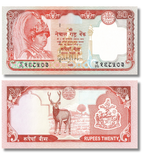
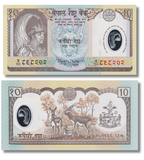
The Nepalese rupee, introduced in 1932, is divided into 100 paisa, but coins below 1 rupee are rarely used due to inflation. Until 2007, banknotes featured portraits of kings (from Tribhuvan to Gyanendra), but after the abolition of the monarchy, they were replaced by symbols. The 100-rupee series evolved: from the portrait of King Birendra (1980s) to Everest (2000s). The new version continues the tradition, reflecting the transition to a republic.
Interesting facts: From Everest to rhinos
Everest on the banknotes is no coincidence: the first ascent in 1953 by Sherpas Tenzing Norgay and Edmund Hillary brought Nepal global fame, increasing tourism by 20% annually. The rhinos, in turn, recall "Operation Rhino" in the 1960s, when King Mahendra saved the species from extinction. And the paisa, as 1/100 of a rupee, is a relic of the colonial era, similar to the British penny, but costs less than chewing gum.
Conclusion: Currency as a mirror of the nation
The new 100-rupee banknote is not just paper but a manifesto of Nepalese identity, ecology, and sovereignty. With an emission volume in billions of rupees, it stimulates the economy, where the currency supports 30 million residents. NRB emphasizes: "The banknote is a national asset, let's take care of it." This release, despite disputes, emphasizes Nepal's resilience in a changing world.