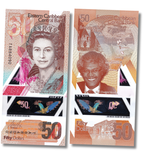

On July 9, 2026, the Eastern Caribbean Central Bank (ECCB) announced the launch of a new banknote series, which will begin entering circulation in 2027. This is an important step in the development of the regional currency: the denominations and color schemes remain unchanged, but the design has been updated to reflect the national pride of the eight countries of the Eastern Caribbean Currency Union (ECCU). Instead of the portrait of Queen Elizabeth II, the front side now features portraits of prominent individuals nominated by each country. These people embody the highest ideals of service, leadership, science, and excellence. The banknotes are printed on Safeguard polymer by De La Rue, size 70 × 145 mm, vertical orientation.
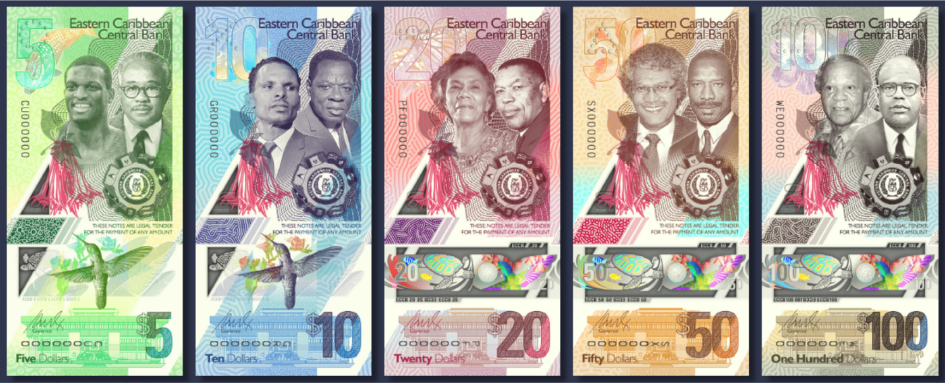
5 Dollars (B247a) — Green Front Side: images of a fish, a sea turtle, a green-throated carib hummingbird, and flowers; portraits of Kirani James (Grenada) — legendary sprinter, Grenada's first Olympic champion (London 2012) in the 400m, multiple world champion — and Robert Milton Cato (Saint Vincent and the Grenadines) — the first prime minister of the independent state, a key figure in the struggle for independence and social reforms. Back Side: Trafalgar Falls (Dominica), map of the islands, Admiral's House in Antigua and Barbuda. Signature: Antoine. Prefix CU. Expected in 2027.
10 Dollars (B248a) — Blue Front Side: portraits of William Henry Bramble (Montserrat) — union leader, first Chief Minister of Montserrat (1960–1970), national hero who defended workers' rights and fought against colonial legacy — and James Ronald Webster (Anguilla) — "father of the nation", first Chief Minister of Anguilla, leader of the 1967–1969 revolution for island autonomy. Back Side: Admiralty Bay, map of the islands, the schooner The Warspite, and a brown pelican. Prefix CR.
20 Dollars (B249a) — Purple Front Side: portraits of Mary Eugenia Charles (Dominica) — "Iron Lady of the Caribbean", the region's first female prime minister (1980–1995), Dominica's first female lawyer who decisively fought corruption and supported regional stability — and Vere Cornwall Bird Sr. (Antigua and Barbuda) — "father of the nation", first prime minister of independent Antigua and Barbuda, who led the process of gaining independence. Back Side: Government House building in Montserrat, map of the islands, nutmeg. Prefix PF.
50 Dollars (B250a) — Brown Front Side: portraits of K. Dwight Venner — prominent economist, long-serving Governor of the ECCB (1989–2015) who made a huge contribution to the financial stability of the region — and Robert Llewellyn Bradshaw (Saint Kitts and Nevis) — key political leader, prime minister whose work was aimed at the socio-economic development of Saint Kitts and Nevis. Back Side: Brimstone Hill Fortress, map of the islands, cannon. Prefix SX.
100 Dollars (B251a) — Olive Green Front Side: portraits of William Arthur Lewis (Saint Lucia) — Nobel Laureate in Economics (1979), first Black Nobel laureate in this field, prominent scholar who developed fundamental theories of economic development — and John George Melvin Compton (Saint Lucia) — first prime minister of independent Saint Lucia, "father of independence" of the island. Back Side: Les Pitons volcanic peaks, map of the islands, bird on a branch. Prefix WE.
The new banknotes do not have a traditional security thread or watermark — these are replaced by modern polymer security features. This series not only updates the currency, but also becomes a powerful symbol of Caribbean identity and respect for its own history.
Vitalii Cherniuk - CEO World Banknote Store