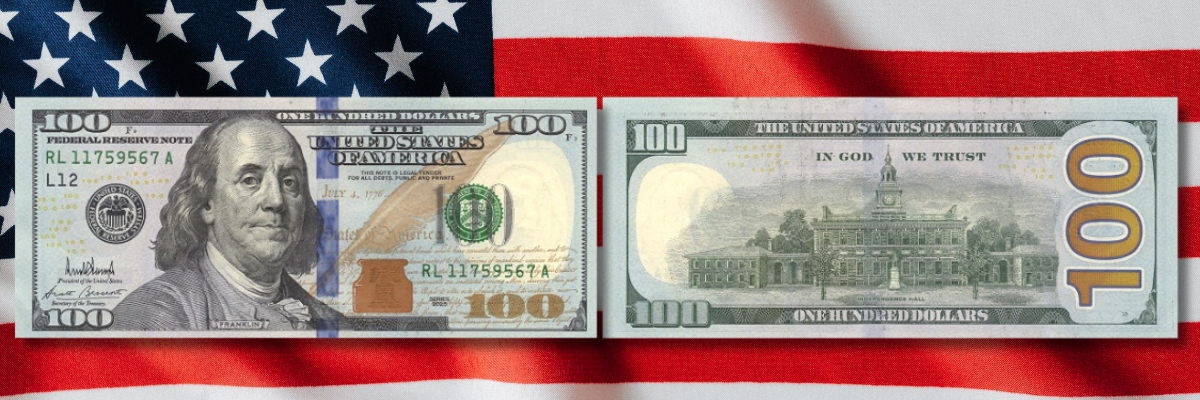
For the first time in US history, the signature of a sitting president will appear on paper currency — and the hundred-dollar bill will be the first to carry it. Here is what is officially known so far, and what remains a matter of time.
A decision not seen in 165 years
On March 26, 2026, the US Department of the Treasury announced a change unprecedented in American numismatics: the signature of the sitting president will appear on the country's currency. Until now, banknotes bore the signatures of the Secretary of the Treasury and the Treasurer of the United States — a tradition that held since the 1860s. Now, the Treasurer's signature is being removed from new printing plates, and Donald Trump's signature will appear in its place alongside current Treasury Secretary Scott Bessent.
Officially, the change was tied to the 250th anniversary of the US — the Semiquincentennial celebrated in 2026. US Treasurer Brandon Beach stated at the time that "the president's mark in history as the architect of America's economic revival" deserves to be reflected on the national currency itself.
The first banknote — the hundred-dollar bill
According to plans by the Bureau of Engraving and Printing, the hundred-dollar bill will be the first to feature the new signature — its printing began in June 2026. Other denominations are expected to receive the updated signature design in the following months.
An important detail for collectors: only the combination of signatures changes, not the portrait or the main banknote design. Benjamin Franklin's portrait, color scheme, denomination, and security elements remain the same — US federal law prohibits depicting living individuals on currency, so replacing the portrait with Trump is out of the question.
Trump revealed the new banknote himself
On July 3, 2026, the President shared an image of the hundred-dollar bill with his own signature placed above Bessent's signature on his Truth Social account. This became the first public display of what the updated bill will look like.
Bessent wrote on the same day that there is no more powerful way to commemorate the achievements of the country and the president than dollar bills bearing his signature, calling it appropriate for the 250th anniversary. Treasurer Brandon Beach added that he expects these banknotes to enter circulation "in the near future."
Can they be found in wallets yet
To be precise: as of early August 2026, there is no official confirmation of the widespread appearance of the new banknotes in circulation. This involves the final stage of the process — passing from printing to distribution usually takes several weeks until the Federal Reserve System dispatches new batches of banknotes to banks.
According to reports from mid-July 2026, the banknotes were expected to enter "broader circulation" through the Federal Reserve banking system in the coming weeks; however, no exact date was given for when they will be massively issued at teller windows and ATMs. Meanwhile, the Treasury continues to print banknotes with the "old" signatures — former Treasury Secretary Janet Yellen and former Treasurer Lynn Malerba. This means both versions of the hundred-dollar bill will coexist in circulation for a while — which collectors seeking early examples of the new issue should keep in mind.
Not everyone is thrilled
The decision caused a stir in US political circles. Congressman Jimmy Gomez introduced a bill that would ban placing the signature of a sitting president on the nation's currency or securities — effectively an attempt to legally override the innovation. To stop the change, such a bill would have to pass the House of Representatives and the Senate, and then receive the President's signature or override a veto — making its chances of quick passage low.
Critics point out that placing a sitting head of state's signature on currency blurs the traditional line between the presidency and the purely technical endorsement of currency by the finance ministry — a line maintained in the US for over a century.
What this means for collectors and numismatists
For the global community of banknote collectors, this change is a rare event: a sitting head of state's signature on paper currency of a major economy happens infrequently, and for the US, it is a first in the entire history of the dollar. The first new-style banknotes, once officially in circulation, will likely attract heightened collector interest — as traditionally occurs with banknotes that capture an historic precedent.
The Bonistics editorial team will monitor developments and report as soon as official confirmations of the mass circulation of the new hundred-dollar bills emerge, along with details regarding subsequent denominations.