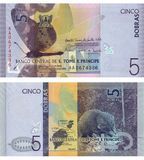

The Central Bank of São Tomé and Príncipe (Banco Central de São Tomé e Príncipe) has officially issued a new commemorative banknote with a face value of 50 dobras, dedicated to the 50th anniversary of the country's proclamation of independence. This is the second anniversary release commemorating the half-century statehood of the small island republic in the Gulf of Guinea — and undoubtedly one of the most vibrant banknote releases in Africa in recent times.
A Banknote Like No Other
The new banknote received the catalog number B317a (PNL) according to the Banknote Book system and is designed in a rich green and gold color scheme characteristic of the tropical nature of the islands. Its size is 145 × 67 mm, which is slightly smaller than the current 50 dobras circulation banknote of the 2018 series. The banknote is printed on a PolySecure polymer substrate produced by the Vietnamese company Q&T Hi-Tech, rather than paper as previously assumed; the printing company was Royal Joh. Enschedé (RJE).
The front side of the banknote depicts two representatives of the local fauna appearing to engage in a dialogue: the Peregrine Falcon (Falco peregrinus) — a high-speed bird of prey found on the islands — and the African Grey Parrot (Psittacus erithacus), one of the symbols of São Tomé's rainforests. Ferns, tropical vegetation, and a waterfall in the background complement the composition. It also features a portrait of Rei Amador — a national hero whose image has traditionally adorned the dobra since its introduction in 1976, along with the national coat of arms and an inscription marking the 50th anniversary of independence: "50° Aniversário da Independência Nacional, Decreto n.º 09/2025". The denomination is placed in the upper right corner and executed with special optically variable ink (OVI) that shifts from gold to green depending on the viewing angle. Next to the denomination, an iridescent cacao pod draws attention — it is not a registration device as previously claimed, but integrated directly into the transparent window of the polymer substrate during manufacturing.
The reverse side serves as a true geographical landmark of the country. It features a contour map of the Americas and Africa with the Equator line, as well as a detailed landscape of the archipelago itself showing where the Equator crosses the islet of Ilhéu das Rolas. Nearby is an inscription referring to the geodetic and astronomical research of Gago Coutinho conducted from 1916 to 1918, along with an image of the historical monument Marco do Equador — a famous monument on Ilhéu das Rolas marking the point where one can stand in both the Northern and Southern Hemispheres simultaneously.
The banknote is signed with the tenth signature pair in the history of the dobra — Guadalupe / dos Santos; it carries the prefix A and an emission issue date, although it actually entered circulation recently.

Why the Falcon, Parrot, and Equator
The design of the new banknote masterfully combines nature, science, and history. The peregrine falcon and gray parrot symbolize the richness of the archipelago's avifauna, which, due to its isolated island position, possesses an extraordinarily high level of endemism — hosting numerous species of birds, butterflies, and plants found nowhere else on Earth. The equator theme for São Tomé and Príncipe is not merely a geographical curiosity, but a core part of the national identity: the islet of Ilhéu das Rolas is one of the few places on the planet where the zero-latitude line crosses land, and it was here, following Gago Coutinho's work, that the Marco do Equador marker was erected, remaining one of the country's main tourist attractions.
Rei Amador's presence on the banknote pays tribute to the 1595 slave rebellion he led, considered one of the largest uprisings against slavery in Atlantic history. After independence was declared, Amador was officially recognized as a national hero, and since 1976, when the dobra replaced the Portuguese escudo, his portrait (reconstructed by an artist as no life portraits survived) became a staple element of almost every banknote in the country.

Second Commemorative Banknote of the Year
The release of the 50 dobras continues the series of commemorative banknotes marking the 50th anniversary of São Tomé and Príncipe's independence, celebrated at Independence Square in the capital. Alongside this issue, the central bank is forming a dedicated line of commemorative currency coexisting with the current 2018 circulation series (denominations of 5, 10, 20, 50, 100, and 200 dobras on a polymer substrate depicting butterflies, birds, and the central bank building), introduced following the redenomination when 1000 old dobras equaled 1 new dobra.
For banknote collectors, this note holds particular interest for several reasons: a limited thematic issue tied to a specific historical event; and a harmonious blend of environmental and historical-geographical symbolism within a single design.