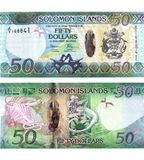

On June 18, 2026, the Central Bank of Solomon Islands (CBSI) officially issued a new commemorative 50-dollar banknote (B230a). This issue marks the bank's golden jubilee — 50 years since its founding. The theme of the anniversary, "50 years of resilience and progressive development," highlights the CBSI's contribution to maintaining economic stability, strengthening the financial system, and promoting the country's development in Oceania. The banknote is printed on the modern SafeGuard polymer substrate from De La Rue, which ensures high durability, resistance to damage, and improved security features. Its mintage is limited to one million copies, but it will circulate in parallel with regular 50-dollar banknotes.
Banknote Design: Cultural Heritage and Modernity
The 145 × 66 mm banknote is executed in rich purple, green, and yellow tones. The obverse depicts traditional elements of Solomon Islands culture: basket weaving patterns, an eagle's head, traditional Bokolo shell money, the country's flag, carved birds, the anniversary logo, and the coat of arms of the Solomon Islands. The text is in English. The reverse features Bokolo shells, modern smartphones (a symbol of digitalization), and the Central Bank headquarters building in Honiara. The watermark (shadow) is CBSI / 50. There is no traditional security thread, but other advanced security features adapted for machine processing are present. Signatures: Forau/Dentana (Sig. 9), prefix A/17. The design combines tradition with modernity, reflecting the country's journey from independence to technological progress.
History of the Solomon Islands Currency
The Solomon Islands gained independence from Great Britain on July 7, 1978. The Solomon Islands dollar (SBD) was introduced in 1977, replacing the Australian dollar at parity. This became a symbol of financial independence. Previously, the Australian pound was used, and even earlier, local traditional forms of money such as dolphin teeth or shells. The currency has endured periods of inflation, particularly during the civil conflict of 2000–2003. Today, 1 SBD ≈ 0.12–0.13 USD. Banknotes are often adorned with images of local flora, fauna, traditional canoes, and cultural symbols. The transition to polymer substrates is a global trend that increases security and service life. Interesting fact: in remote areas of the country, traditional forms of money are still used alongside modern currency. In 2008, due to currency devaluation, a coin shortage occurred — islanders began collecting them as souvenirs.
Significance of the Commemorative Banknote
The new banknote is not just a means of payment, but also a cultural and educational tool. It honors 50 years of CBSI's work under difficult conditions: from economic instability to natural disasters (the islands often suffer from cyclones and earthquakes). The limited mintage makes it attractive to collectors. De La Rue's SafeGuard polymer technology includes elements visible from different viewing angles and tactile markers (for example, 10 raised dots for the visually impaired). This meets international standards of inclusivity.
Conclusion: The Future of Currency in Oceania
The commemorative 50-dollar banknote of the Solomon Islands demonstrates how small states use banknotes to strengthen national identity and economic modernization. It combines respect for traditions with innovation, highlighting the resilience of a people who have survived numerous challenges. For numismatists and economists, this is an important event in the history of Pacific currency. Such an issue reminds us that banknotes are not just money, but also history, culture, and a vision of the future.
Vitalii Cherniuk - CEO World Banknote Store